Manufacturing Technologies and Internal Layer Integrity
Flat-die extrusion vs. Blown Film Technology
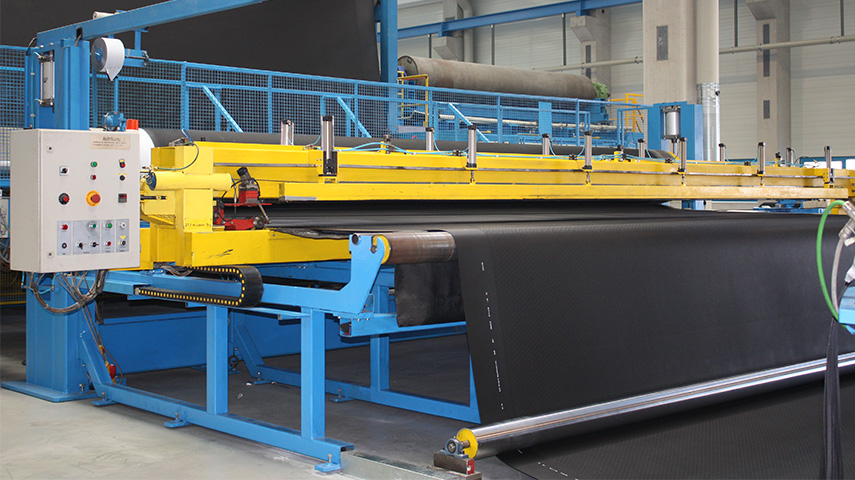
HDPE geomembranes can be manufactured using different extrusion technologies. One established approach is flat-die extrusion, where the molten polymer is extruded and subsequently shaped and calibrated through calender rolls to form a monolithic sheet with a homogeneous structure across its entire thickness. This process allows precise control of thickness tolerances, material density, and mechanical properties across the sheet width.
An alternative approach used by some manufacturers is blown film extrusion. In this process, the geomembrane is produced as a tubular film, which may consist of multiple co-extruded layers that are later collapsed and flattened into a sheet. Due to the nature of the process, the material experiences different stresses in the machine and transverse directions during production. This can lead to orientation effects and variations in mechanical properties depending on direction. In addition, the wall thickness distribution may be less uniform compared to flat-die extrusion, particularly if process parameters are not tightly controlled.
From a processing standpoint, both technologies can produce geomembranes that meet short-term specification requirements when properly controlled. However, the differences in manufacturing principles should be considered when evaluating long-term performance, structural homogeneity, and consistency for demanding containment applications.
Homogeneity and Quality Control of the Core Layer
Flat-die extrusion geomembranes, the material composition is homogeneous across the full thickness. Raw material quality, additive content, and formulation consistency can be verified through established test methods such as density measurements, Differential Scanning Calorimetry (DSC), Oxidative Induction Time (OIT), mechanical testing, and long-term performance tests. Any deviation in formulation affects the entire sheet and is therefore more readily detectable.
In contrast, multilayer geomembranes produced via blown film technology may contain distinct functional layers, typically with higher-quality material on the outer surfaces and a different formulation in the core layer. From a quality assurance perspective, this raises a fundamental challenge:
The properties of the middle layer are difficult or, in some cases, impossible to verify using standard acceptance testing.
Limitations of Conventional Testing Methods
Most standard geomembrane tests—tensile properties, elongation, OIT, carbon black content, and dispersion—are performed on the full cross-section or on surface-extracted samples. These methods primarily reflect the properties of the outer layers, which are directly exposed and mechanically engaged during testing.
Potential deviations in the core layer, such as:
• Use of lower-grade polymer
• Increased recycled or post-consumer content
• Reduced additive concentration
• Inclusion of fillers or foaming agents to reduce material consumption
may remain undetected if the surface layers meet specification requirements. As a result, a multilayer geomembrane can appear fully compliant at delivery while containing internal zones with reduced mechanical integrity or long-term durability.