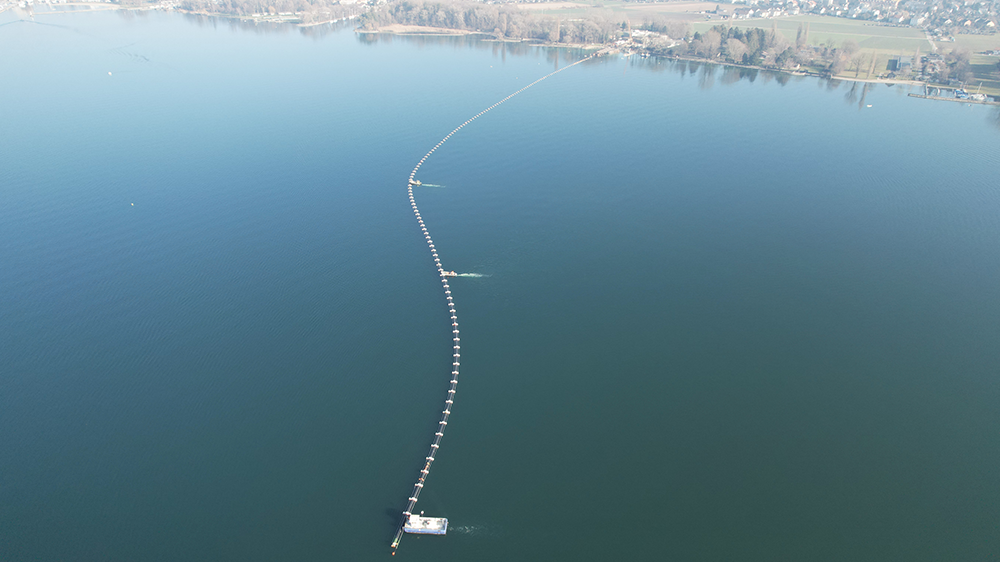
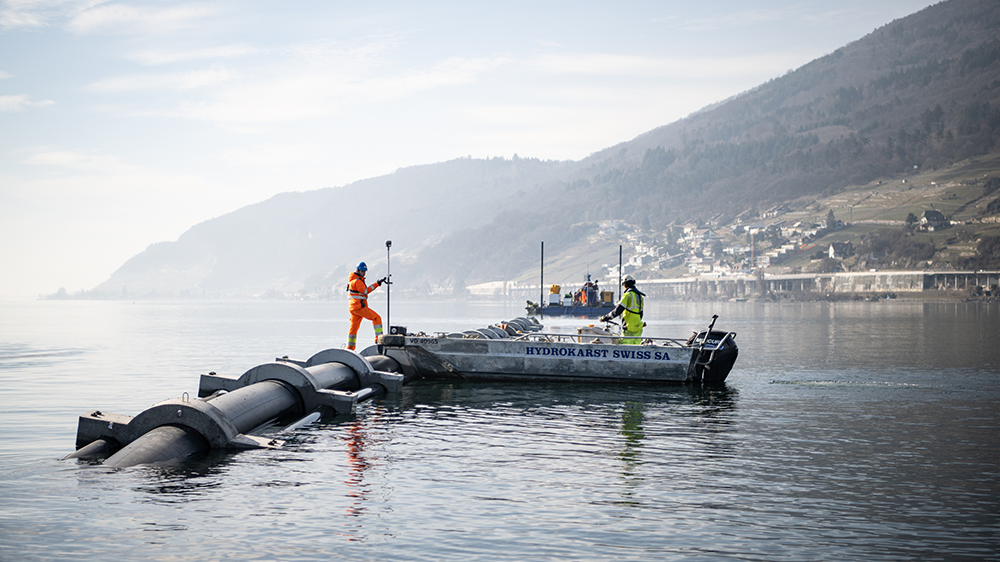
The continuous dimensional accuracy of the pipes as well as the homogeneously executed welded joints allow a mechanical cleaning device to be propelled by water pressure along the entire length without cross-sectional offsets. Pipeline, fittings and intake screen are hydraulically matched and have the same internal diameter. It is crucial that all pipeline components are geometrically continuous and designed without cross-sectional changes.
Quagga Mussels Make Pipeline Cleaning Essential
The trigger for the raw water intake project was the complete refurbishment of the Ipsach Lake Waterworks, taking into account the increasing overgrowth caused by the invasive quagga mussel (Dreissena rostriformis bugensis), which has been spreading in Lake Biel since approximately 2019. The free-swimming larvae settle on surfaces within about four weeks and subsequently form a shell. In the existing lake water intake from the 1970s – a cement-lined steel pipeline with flap construction – mechanical cleaning was not possible.
In conventional pipeline cleaning, a cleaning device is pushed through the pipeline, exits into the lake and is then recovered by boat. Cleaning of this type requires diver and boat operations and interferes with plant operation. In Ipsach, the objective was to develop a system that enables cleaning without any operations on the lake. The aim is to realize a fully automated, weather-independent operation with optimized life-cycle costs.
Geometric Continuity as a Technical Prerequisite
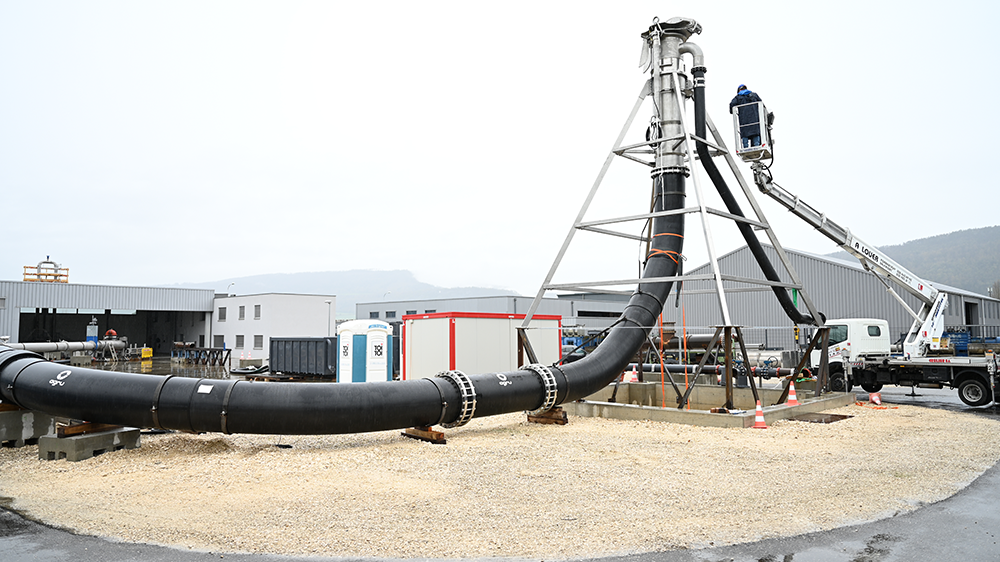
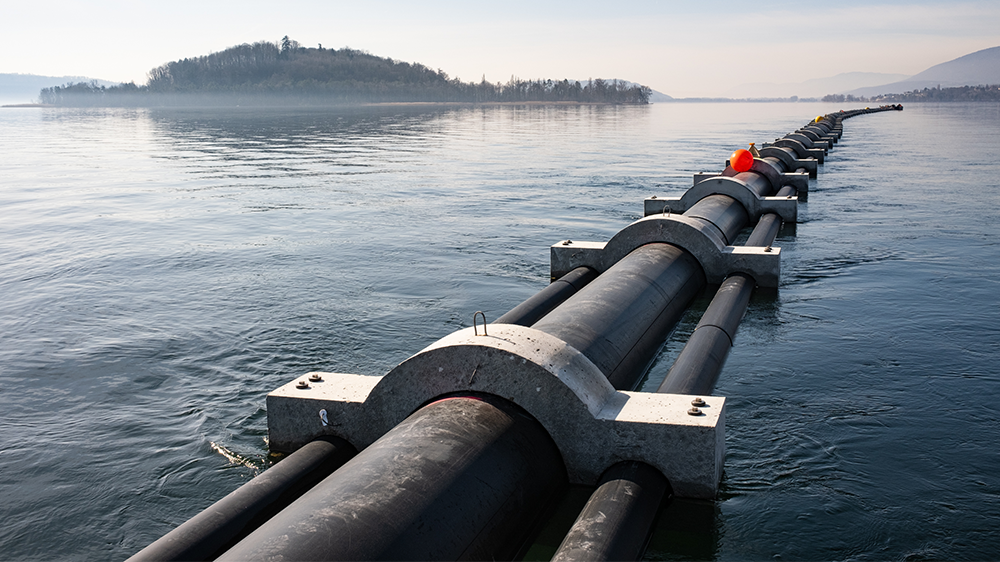
The core of the new plastic piping system consists of two parallel PE 100-RC pipelines with an operating pressure of 2 bar and identical internal diameters from the operations building to the intake point located at a depth of approximately 38 meters. The concept is complemented by a launch and reception chamber, a separate return line and a patented intake screen with the same hydraulic diameter as the pipeline. This geometric continuity is the prerequisite for enabling the cleaning device to travel the entire route bidirectionally without the need for recovery.
For use in the 750-meter pressure pipeline, no relevant ovalities, significant diameter deviations or notable misalignments at weld seams are permissible. Even minor shape deviations increase mechanical resistance and jeopardize passability. The internal contour must remain constant over the entire length.
Precise Manufacturing and Joining Technology
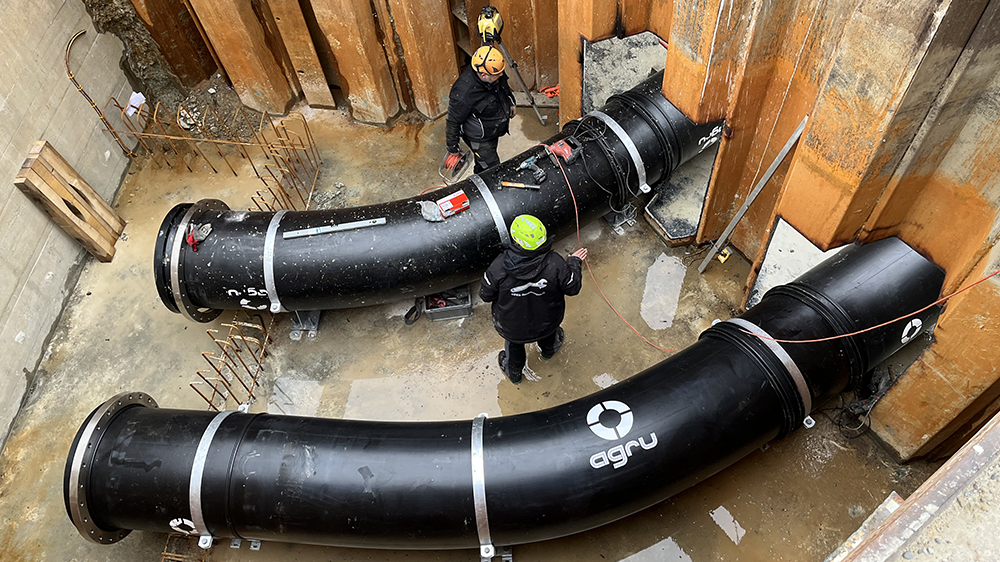
AGRU manufactured the pressure pipes within defined production windows in order to avoid tolerance shifts caused by deformation due to long-term storage. The pipe sections to be welded originated from an identical material batch and were marked as belonging together. AGRU thus provided a plastic piping system precisely tailored to the project. The pipeline sections were joined by means of heated tool butt welding to form homogeneous, longitudinally force-locked units. The objective was a uniform internal geometry with minimal bead offset over the entire pipeline length. According to the operator, the requirements exceeded customary industry tolerances, which were met by AGRU thanks to meticulous preparation.
PE 100-RC as a Material for Long-Term Service Life
Following a variant assessment, PE 100-RC was selected as the material. The decisive factors were corrosion resistance, abrasion resistance and suitability for recurring mechanical cleaning cycles. Compared to coated steel, internal coatings and additional corrosion protection measures are eliminated.
PE 100-RC exhibits increased resistance to slow crack growth and achieves minimum lifetimes of over 8,760 hours in the FNCT according to ISO 16770. For welded pressure pipeline systems, this provides additional long-term safety, particularly in cyclically stressed weld zones. The integral welding across the entire wall thickness creates a monolithic system without detachable sealing connections – a design that is appropriate for a service life of several decades.
Installation at a Depth of 38 Meters Under Controlled Conditions
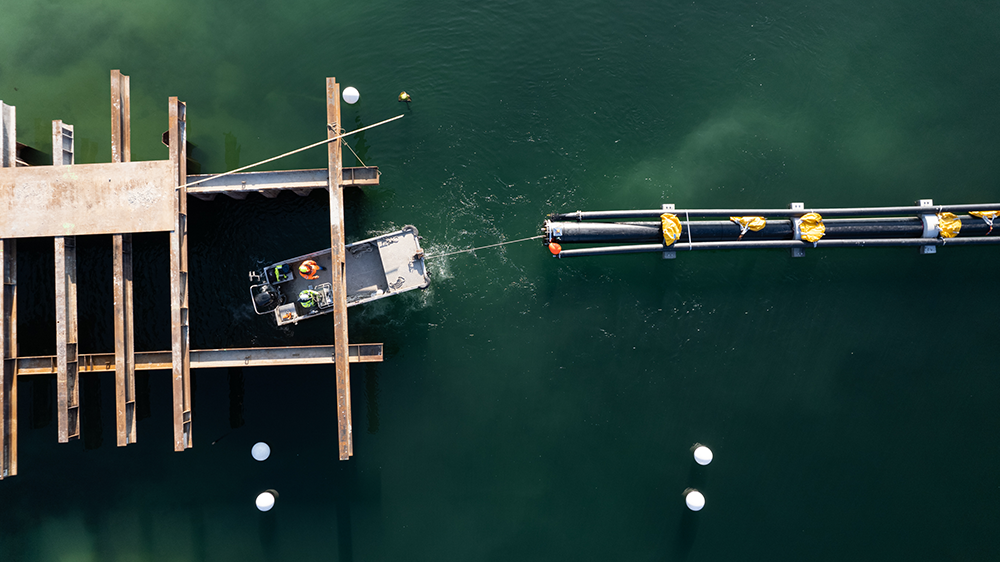
The welding work, the controlled lowering of the lake pressure pipelines and the secure anchoring in the lakebed were carried out by Hydrokarst Swiss SA, a company specialized in underwater works. The company contributed its expertise particularly in the precise alignment and positioning of the DN/OD 800 pipelines at a depth of approximately 38 meters. Due to the density of PE being close to that of water, the lake pressure pipeline could be floated into its exact final position. Controlled lowering in an S-shaped curve was achieved by coordinated filling of the lake pressure pipeline. The intake screen, approximately ten meters high, is located on a sloped section of the lakebed and aligned to follow the shoreline geometry and withstand potential sediment movements. The system was commissioned at the end of 2025.
Dimensional Accuracy as a Functional Requirement
“For the new cleaning system to function, exact dimensional accuracy of the pipelines was essential. AGRU delivered excellent work in meeting our high requirements,” says Hanna Schiff, Project Manager Lake Waterworks Ipsach.
The project serves as a reference for lake water intakes in waters affected by quagga mussels. It demonstrates that fouling control of technical installations in the presence of this invasive organism represents a technical challenge. When pipe geometry, material, fittings and joining technology are designed to allow automated mechanical cleaning without operational interruptions, the maintenance regime fundamentally changes. In Ipsach, the plastic piping system used is therefore a system-supporting prerequisite for permanently reliable lake water intake.