Role of Textured Geomembranes in Slope Stability
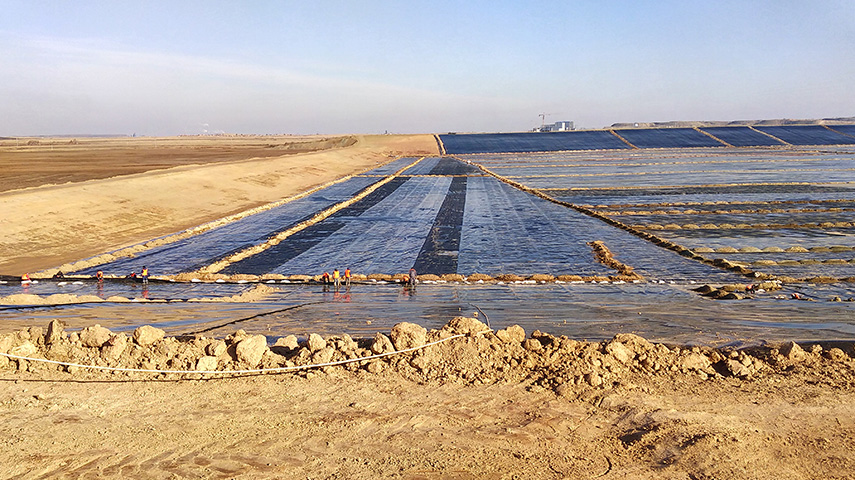
In many containment systems, particularly in mining, landfill engineering, and water reservoirs, slope stability is a critical design parameter. In these applications, structured/ textured geomembranes are not optional enhancements but essential components for ensuring structural and static safety.
Structured geomembranes significantly increase interface shear strength between the liner and adjacent layers such as soil, geotextiles, or drainage composites. This improved frictional behavior directly contributes to slope stability and reduces the risk of sliding failures under long-term loads, seismic events, or extreme hydraulic conditions.
The quality of the texturing process plays an important role. High-quality, well-controlled embossing or structuring ensures:
- Uniform texture height and distribution
- Consistent interface shear performance
- preservation of the geomembrane’s core mechanical properties
In contrast, low-cost structured geomembranes or products with texture applied in a secondary process may exhibit irregular or superficial surface features. While such materials may appear comparable at first glance, they often provide inferior and less reliable shear resistance.
Particularly in the case of spray-applied textures, the risk of particle detachment under compressive or shear loads can be significantly higher than with integrally embossed structures. Additionally, the elevated processing temperatures required for spray-applied surface layers may accelerate oxidative degradation of the polymer particles, which can negatively affect long-term durability and mechanical stability. In critical slope applications, these potential deficiencies can compromise overall system integrity and increase safety risks.