Material Requirements in Sea-Based Operation
Continuous operation in a marine environment places stringent demands on both material and design. Salt water, high UV exposure, pronounced temperature fluctuations between day and night, and continuous mechanical loading caused by wave motion place lasting stress on the structure. In large-area welded structures, the choice of material is therefore a decisive factor in the service life of the unit.
PE 100-RC was selected for this application. The material is engineered for high resistance to slow crack growth and offers significantly greater robustness under notch stress than conventional HDPE. For large-volume marine aquaculture structures in the 30,000 m³ class, this provides an important safety reserve.
Polyethylene is also corrosion-resistant to seawater. Additional protective measures such as coatings, sacrificial anodes or cathodic corrosion protection are therefore not required. For use under the climatic conditions of the Red Sea, the material was additionally stabilised with UV stabilisers and antioxidants to slow photo-oxidation and thermal ageing.
Construction from Welded PE Sheets
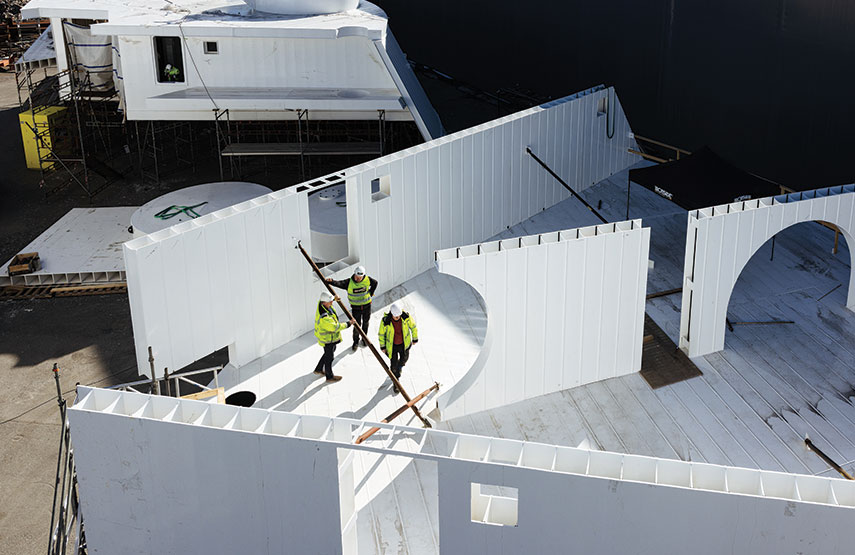
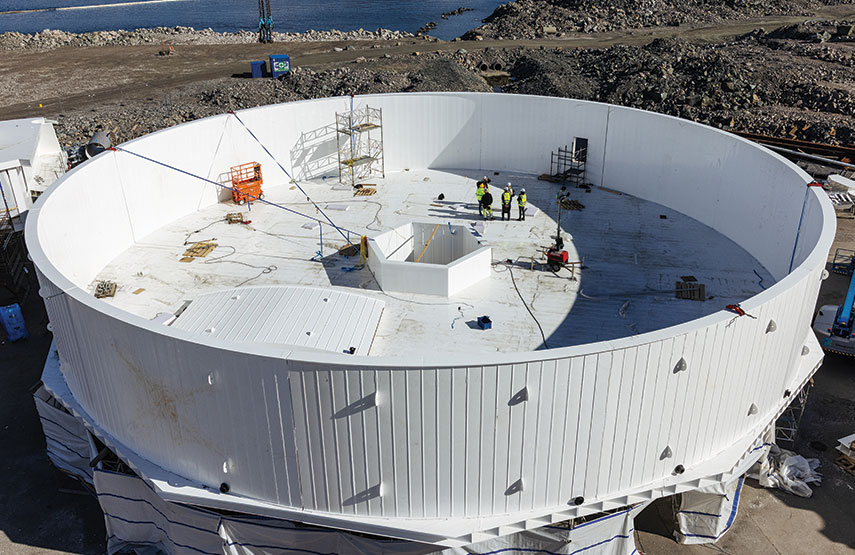
The tank shell of the units is formed from a double-walled welded sandwich construction made of polyethylene sheets. The large-format sheets were bent into segments on site and joined by heated tool butt welding and extrusion welding.
Large-format semi-finished products reduce the total length of the weld seams and therefore the number of joints. The reproducible quality of the large-area welded joints creates connection zones that meet the mechanical requirements of marine operation.
For the construction, AGRU supplied around 600 tonnes of white, highly UV-stabilised PE 100-RC sheets in a 5 × 2 m format and with thicknesses of up to 50 mm. The scope of supply also included welding rods and more than 200 linear metres of PE 100-RC pressure pipe DN 1200 for seawater intake and discharge.
Closed Containment System for Controlled Aquaculture
The operating concept of the units is closed both technically and biologically. Seawater is drawn in under controlled conditions from depths of 45 to 50 m and filtered. This reduces near-surface pollution loads and parasite ingress, while making use of more stable temperature conditions.
Solids from feed residues and faecal matter are captured inside the unit and discharged in a targeted manner. The smooth PE surfaces facilitate cleaning and hygiene management, as marine fouling and microorganisms adhere less readily. An integrated flow channel ensures uniform flow control within the unit.
Project Implementation
The closed containment aquaculture concept was developed by FishGlobe. The aquaculture units with integrated flow channels were manufactured on a project-specific basis by industrial partner Bluegreen.
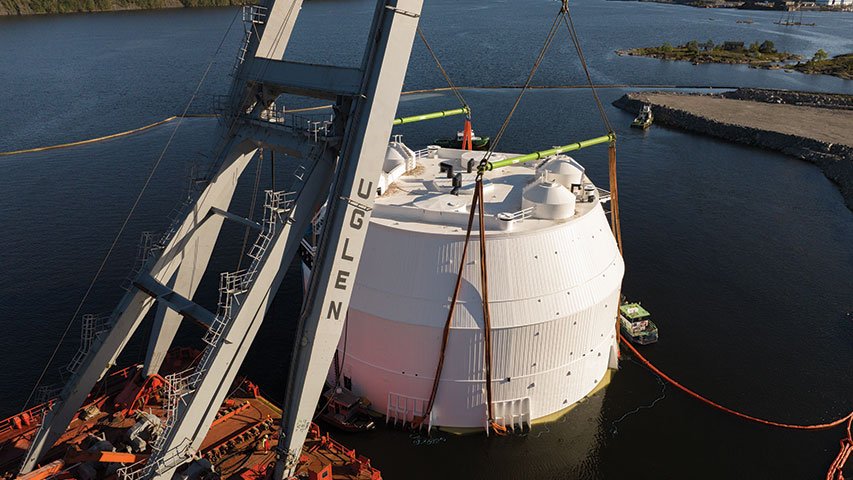
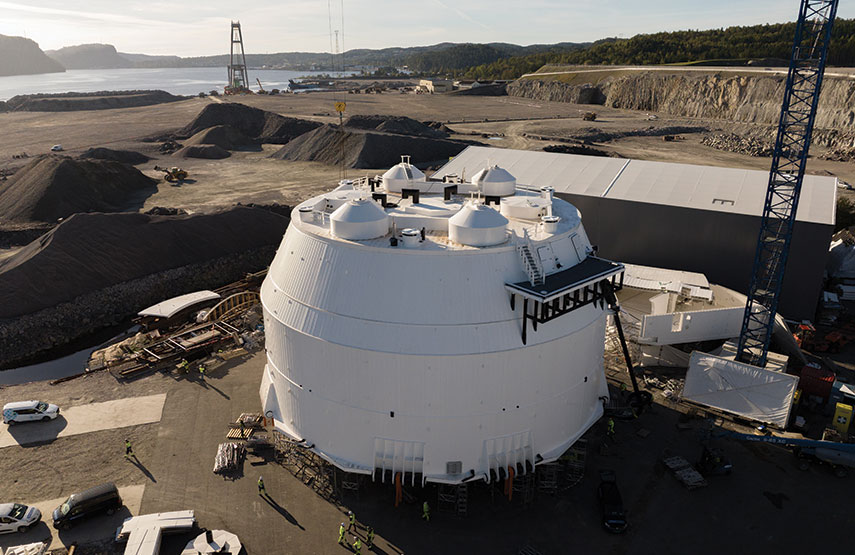
At the end of September 2025, Bluegreen launched the FishGlobe 3.5K (3,500 m³) and FishGlobe 10K (10,000 m³) units at the Frier Vest site as part of a heavy-lift operation. The units measure 14 m in height and 23 m in diameter, and 17 m in height and 33 m in diameter respectively.
After completion of inspection and testing, the aquaculture units were transferred to an international customer in Saudi Arabia, where they are now in operation.
AGRU as Material and System Partner
AGRU supported the development of the project as a material and system partner. Its scope of services included suitable materials for semi-finished products and piping components, as well as application-technical consulting, welding technology, special formats and coordinated delivery logistics.
This close integration of services proved particularly relevant under site conditions involving crane operations, welding work and tight time windows. AGRU contributed materials engineering expertise as early as the planning and design phase and supported the project with corresponding recommendations.
In parallel, preparations are under way for the largest unit in the system to date: FishGlobe 30K, with a volume of 30,000 m³.
“The close cooperation and AGRU’s deep understanding of the challenges involved in using plastic products in marine environments made a decisive contribution to the successful implementation,” says Albert Lueghamer, Head of Technical Department at AGRU.